
The Diaper Rash Nobody's Talking About: How Disposables Quietly Became India's Newest Parenting Problem
For mamas navigating the newborn haze
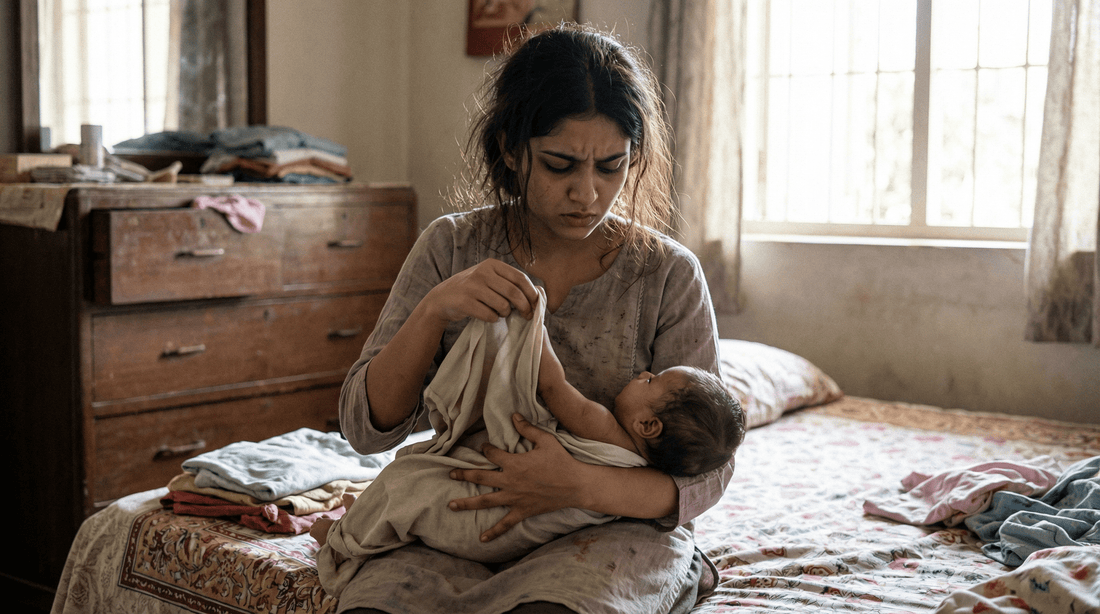
I was at a kirana store in Bandra last monsoon, watching a young mother — baby on her hip, toddler pulling at her dupatta — scan the shelf of diapers with the expression I know well. Not excitement. Calculation. She picked up the imported brand, checked the price, put it back. Picked up the mid-range one, checked again. Eventually settled on the economy pack, tucked it under her arm like it was just another item on the list, and moved on.
It's such an ordinary scene. And that's exactly what worries me.
Somewhere between our mothers' generation of cotton langots and today's supermarket diaper aisle, something shifted quietly — in our homes, in our garbage, and on our babies' skin. And most of us, including me for the first year of my daughter's life, didn't stop to question it.
How We Got Here: A 30-Year Market Story
Disposable diapers arrived in urban India in the early 1990s, riding in on the same wave of liberalisation that brought us cable TV and Maggi noodles. Pampers and Huggies initially marketed to upper-middle-class families in metros — Delhi, Mumbai, Bengaluru — positioning diapers as a marker of modern, aspirational parenting.
It worked. By the 2000s, the category had expanded aggressively. Domestic players like Mammypoko (Unicharm) entered with lower price points, and the diaper stopped being a luxury item and started becoming a perceived necessity. Today, India's baby diaper market is valued at over ₹12,000 crore and growing at roughly 12–15% annually, according to industry estimates. Tier 2 and tier 3 cities are now the primary growth frontier.
The urbanisation piece matters here. As more Indian families moved into apartments — smaller spaces, no courtyard to dry cloth nappies, both parents working — disposables became genuinely practical. This isn't a story about bad choices. It's a story about a product that found a real need and then quietly created several new ones.
The Rash Problem Nobody Prepared Me For
Let me be direct about something: diaper rash in India is both underreported and undertreated.
A 2019 study published in the Indian Journal of Dermatology found that irritant contact dermatitis — the clinical term for diaper rash — affects between 25–35% of infants at any given time in India, with incidence peaking in the 6–12 month window. But here's what the statistics don't capture: how many mothers are quietly managing it with home remedies because a paediatrician visit feels expensive or unnecessary for "just a rash."
Disposable diapers, particularly economy-segment ones, are a significant contributing factor. Modern disposables contain a mix of wood pulp, superabsorbent polymer (SAP), synthetic fragrance, and chemical adhesives. For a baby's skin — thinner, more permeable, more reactive than adult skin — prolonged contact with these materials, especially in India's heat and humidity, is a set-up for irritation.
The problem is compounded by something specific to how diapers are used in Indian households: extended wear time. In a country where a pack of 44 diapers can cost ₹800–1,200, many families — even financially comfortable ones — stretch each diaper longer than the recommended 3–4 hour window. I did this. Most mothers I know did this. The diaper companies know this too, which is why "12-hour protection" is considered a selling point rather than a red flag.
Twelve hours of a synthetic absorbent pad against newborn skin in Chennai in July. Think about that for a moment.
The Environmental Problem Is Worse Than You Think
Here's where I have to shift the lens, because this is the part most Indian parenting content carefully avoids.
A single disposable diaper takes approximately 500 years to decompose. The average Indian baby, if exclusively on disposables, will use roughly 4,000–6,000 diapers before toilet training. Multiply that by the estimated 25 million babies born in India each year, even accounting for partial adoption, and you're looking at a waste volume that our municipal systems are structurally unprepared for.
India processes less than 30% of its solid waste effectively, according to the Ministry of Housing and Urban Affairs' own data. Soiled diapers — classified as mixed waste, neither purely dry nor safely wet — routinely end up in landfills, open dumps, or worse, waterways. Unlike urban metros with some waste segregation infrastructure, smaller cities and towns have almost no mechanism for handling diaper waste separately.
What's particularly frustrating is that this isn't a problem that appeared suddenly. The diaper industry's growth projections have been public knowledge for a decade. The infrastructure response has been essentially nonexistent.
Why Families Still Choose Them (And Why That's Completely Reasonable)
I want to be careful here, because it would be easy — and dishonest — to make this into a simple villain story.
Disposable diapers genuinely solve real problems. For a working mother returning to an office at three months postpartum, cloth nappies requiring soaking, washing, and drying are not a realistic option. For a family in a two-room house without outdoor drying space, the logistics don't work. For a grandmother managing a baby while her daughter recovers from a C-section, the convenience is not trivial.
The marketing has also been sophisticated and aspirational in ways that are hard to resist. Disposables were sold to Indian mothers not just as convenient, but as hygienic — the implicit message being that cloth nappies were backward, unhygienic, old-fashioned. A generation of mothers absorbed this messaging and passed it to their daughters. My own mother, who used cloth for me, was the one who came home from the hospital baby shower with two packs of Pampers "just to have."
The problem isn't that families made irrational choices. The problem is that the full cost of those choices — to their baby's skin, to their wallet over time, to the environment — was never part of the conversation. The companies certainly weren't going to start it.
What's Actually Worth Considering
I'm not going to tell you to switch cold turkey to cloth. That's not realistic for everyone, and frankly, modern cloth diapering requires its own learning curve, upfront investment, and access to clean water — not always a given across India.
But a few things are worth sitting with:
Hybrid use works. Many paediatricians now suggest disposables for nights and outings, cloth or cotton nappies during the day at home. It reduces both skin exposure and waste without requiring an all-or-nothing commitment.
Economy diapers carry higher risk. The cheaper the diaper, the more likely it is to contain lower-grade absorbent materials and stronger chemical adhesives. If budget is a constraint, fewer changes of a mid-range diaper may actually be better than frequent changes of the cheapest option — though more research on Indian market products specifically is genuinely needed here.
The langot is not as difficult as you remember. Modern cotton langots and cloth inserts have improved significantly. Several Indian brands now make pre-fold cloth options that work with a simple waterproof cover. It's not your grandmother's pin-and-pray system.
Diaper-free time is legitimate medicine. Consistent daily periods without any diaper — even 30–45 minutes morning and evening — dramatically reduce rash incidence. This is documented, simple, free, and somehow never mentioned on the back of any diaper pack.
The Question I Keep Coming Back To
The young mother at the kirana store made her choice and moved on. She was doing what most of us do — navigating real constraints with the information and resources available to her.
What I keep wondering is: who is responsible for making sure she has the complete picture? Not just the "ultra-dry, 12-hour protection" pitch, but the skin science, the waste reality, the alternatives?
It's not her job to research polymer chemistry between feeds. It shouldn't have been mine either.
India's diaper rash problem — the one on babies' skin and the one growing quietly in our landfills — isn't really about individual choices. It's about what information gets amplified, what products get shelf space, and whose convenience the system is actually designed for.
That's a bigger conversation than any one mother can solve on her own. But it starts, I think, with knowing there's a conversation to be had at all.
Apna aur apne bachche ka khayal rakhna — take care of yourself and your little one.