

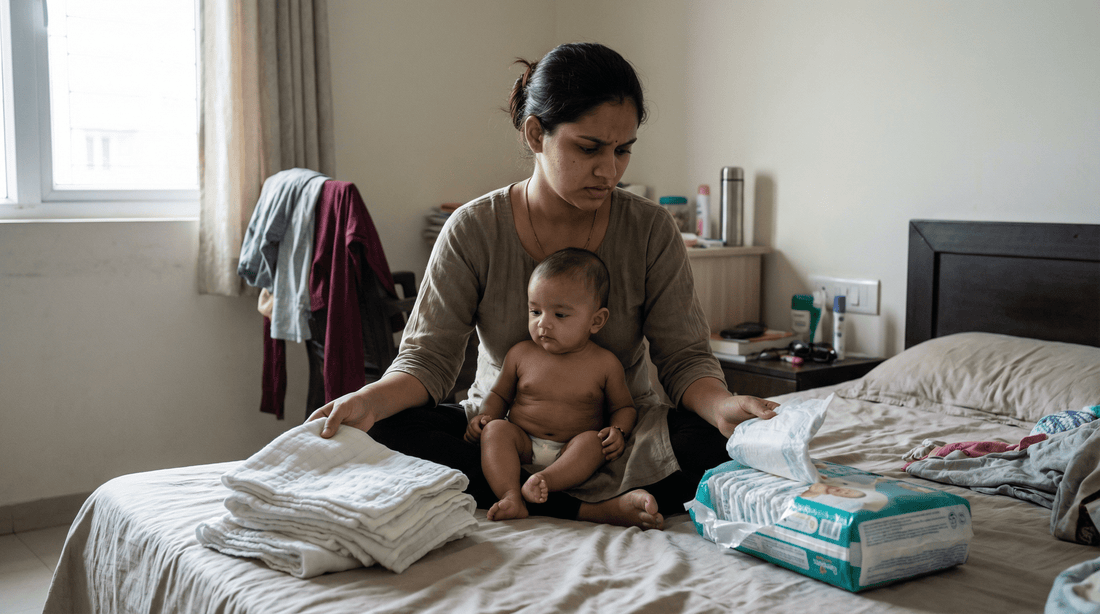
Muslin Reusable Diapers vs Disposable Diapers: What Actually Works for Indian Families
I still remember one night — around 2:30 AM, fan on full speed, Mumbai humidity doing its thing. My baby had just fallen asleep after what felt like hours of crying, and I was standing there with a diaper in my hand, half asleep, completely confused.
Should I use another disposable… or try the muslin cloth my mom had been insisting on?
At that moment, it wasn’t just about diapers. It was about not waking the baby again, not overspending (because diapers are not cheap), and not feeling guilty about rashes or waste.
If you’re a new parent reading this, chances are you’ve had a similar moment.
Let’s talk honestly — no brand talk, no perfect parenting — just what actually works in Indian homes.
The Honest Comparison
Here’s the breakdown I wish someone had shared with me earlier:
| Factor | Muslin Reusable Diapers | Disposable Diapers |
|---|---|---|
| Cost | ₹1,500–₹3,000 one-time for 10–15 pieces | ₹1,500–₹3,000/month (₹18k–₹30k/year) |
| Convenience | Needs washing, drying, folding | Use & throw, very easy |
| Skin Health | Breathable, fewer rashes | Can cause rashes if worn long |
| Environment | Reusable, low waste | Each diaper takes ~500 years to decompose |
| Indian Climate Fit | Great for hot weather | Can trap heat in summers |
| Travel | Inconvenient | Very practical |
| Night Use | Needs frequent change | Works better for longer sleep |
The Reality No One Talks About
Let’s move beyond Instagram-perfect parenting.
Washing Isn’t Always Easy
When I first tried muslin, I thought — “Arre, kitna hi mushkil hoga?”
Reality:
- 6–8 cloth changes a day
- Soaking, rinsing, washing
- Drying space issues
If you live in an apartment without proper sunlight or balcony space, it can become exhausting, especially during monsoon.
A friend from Pune once told me:
“Daytime I managed cloth, but during monsoon everything stayed damp. I had to switch back.”
Family Opinions Can Be Confusing
If you’re in a joint family, you’ve probably heard both extremes:
- “Humne toh kabhi diaper use nahi kiya”
- “Cloth is unhygienic, use branded diapers only”
And you’re stuck in the middle, trying to figure out what’s actually right.
The truth? Both sides have some valid points.
Nights Are a Different Story
This was my biggest learning.
During the day, cloth works beautifully.
But at night, sleep matters more than anything.
Muslin diapers need to be changed every 2–3 hours. That means waking the baby, which means waking yourself again and again.
After a few sleepless nights, I switched to disposables at night — and honestly, it saved my sanity.
Going Out Changes Everything
Let’s be real:
Ghar par toh theek hai, lekin bahar…
Cloth diapers outside the house can be stressful:
- No place to wash
- Carrying used cloth
- Leakage worries
Disposables are just easier here. No debate.
What About Rashes?
This is something many parents quietly deal with.
In Indian weather — heat and humidity — babies sweat more. If a disposable diaper stays on for too long, especially cheaper ones, it can irritate the skin.
I learned this the hard way.
At first, it was mild redness. I ignored it. Then it got worse.
Our pediatrician simply said:
“Give diaper-free time. Let the skin breathe.”
That changed everything.
Muslin diapers are more breathable, so they help reduce this risk. But even with disposables, frequent changes and diaper-free time make a huge difference.
When Muslin Reusable Diapers Work Best
Muslin works really well in these situations:
- At home during the day
- When you’re trying to save money
- If your baby has sensitive skin
- During hot summer months
- When you have time to manage washing
A mom from Bangalore shared:
“I switched to muslin in summer, and rash problems almost disappeared.”
When Disposable Diapers Make More Sense
Disposables are more practical when:
- It’s night-time and you need uninterrupted sleep
- You’re travelling or stepping out
- You’re a working parent with limited time
- During monsoon when drying cloth becomes difficult
- You don’t have support at home
Another parent told me:
“I tried going fully cloth. Gave up in 10 days. Hybrid saved me.”
What Most Indian Parents Actually Do (The Hybrid Approach)
Here’s the truth no one really says openly:
👉 Most parents don’t choose one. They mix both.
- Cloth during the day at home
- Disposable at night
- Disposable when going out
- Some diaper-free time daily
This approach works because it balances everything:
- Cost
- Convenience
- Baby’s comfort
- Your mental peace
Let’s Talk Cost (Because It Matters)
Over one year:
- Disposable-only: ₹18,000–₹30,000
- Muslin setup: ₹2,000–₹4,000
Even if you go hybrid, you can reduce diaper costs by 40–60%.
For many families, that’s a meaningful saving.
One Thing I Wish I Knew Earlier
No option is perfect.
Cloth requires effort. Disposable costs more and can affect skin if not used carefully.
But parenting isn’t about choosing the “perfect” option.
It’s about choosing what works for your baby, your home, and your energy levels.
Some days you’ll prioritize convenience. Some days you’ll choose sustainability.
Both are okay.
A Small Tip That Made a Big Difference
Give your baby at least 30–45 minutes of diaper-free time every day.
No product. No cost. Just letting the skin breathe.
It sounds simple, but it really helps.
Before You Decide
If you’re confused, don’t overthink it.
Try both.
Use muslin for a few days. Try disposables at night. See how your baby responds and how you feel managing it.
Every home is different. What works for one may not work for another.
Let’s Talk ❤️
Are you currently using cloth, disposable, or a mix?
What has been the hardest part for you — washing, cost, or handling family advice?
Share your experience — it might help another parent going through the same phase.